Monday
Oct292012

Auburn McCanta

Welcome to Fast Five: short interviews with my favorite writers. Life may be short but who doesn't have time for five questions?

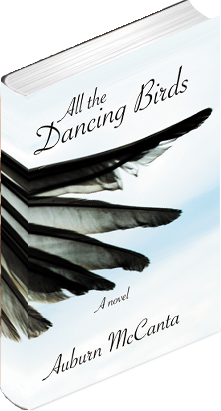
Auburn McCanta is an award-winning writer, poet, journalist, and advocate. Surviving a brain tumor nearly 20 years ago inspired McCanta to write her first novel, All the Dancing Birds.

In the story, Lillie Claire Glidden is unraveling. She knows she’s in trouble when she finds her wallet and keys deep in the refrigerator. Not even her favorite red wine can dull the pain of the dreaded diagnosis: Alzheimer’s.

Told from Lillie Claire’s perspective, All the Dancing Birds offers beautiful and terrifying insight into the secret mind of those touched — and ultimately changed — by the mystery of Alzheimer’s disease.

I’m intrigued with the genesis of this novel: your brain tumor. Can you give us a bit of backstory?

I’m a brain tumor survivor of eighteen years. I still remember how my hands trembled in my lap as I received the initial kick-in-the-gut diagnosis that I had a tumor, a little larger than a golf ball, squatting deep and ruinous inside my brain. I was then given the unpleasant task to prepare for a number of terrifying outcomes, each one more frightening than the one before. In the world of brain tumors, full recovery is generally the last item on a long list of other more probable and very unkind possibilities. Nevertheless, with a gifted surgeon, a great deal of love and support and the luck to have inherited my grandmother’s stubborn Irish streak, I was given the gift of a shiny new life.

During the months following surgery, I taught myself to walk again, to talk again. To live again.

It seemed only natural after surviving a brain tumor, that I would develop a keen interest in other brain diseases as well. As time went on, I spent many years with family members and friends who suffered from Alzheimer’s disease. After my own experience as a brain tumor patient, it dawned on me one day—like lightning in a bottle—that I retained the ability to think, even when it wasn’t clear to anyone else. I compared my early days following brain surgery, when I was unable to intelligently communicate, to the latter days of my loved ones with Alzheimer’s, who were equally unable to communicate. In recalling how difficult it was to locate and form words (a condition called, aphasia), it occurred to me that even in my darkest times, when my reasoning was skewed or my thoughts were slow in forming, I nevertheless retained the ability to think—however narrow those thoughts might have been. I retained a lively imagination and, even when I felt jumbled with medication or all those blind alleys I wandered through within the quiet of my mind, I still never stopped thinking. Similarly, I’ve watched dementia patients, silent and sometimes unapproachable, light up whenever someone might simply stop, take their hand, look into their face, and croon a soft hello.

It’s the notion that thought does not cease—regardless the circumstance—that I wanted to fictionalize.

I believe insight and knowledge is as possible through fiction as it is through clinical and nonfiction studies, that fiction teaches and illuminates and clarifies in different ways. A story can surprise and educate in creative ways; it can let readers explore difficult subjects through imagination and storytelling.

Statistics can be so clinical. You managed to turn dramatic data (5.5 million people in the U.S. with Alzheimer’s!) into a personal story that is both moving and illuminating. How were you able to capture the inner life of this disease of deterioration?

Alzheimer’s disease has been described as a rabbit hole into which entire families fall but, unlike Alice, there is no return to normal.

There is no single look to Alzheimer’s, just as there is no particular demographic that is either susceptible or immune. For those with Alzheimer’s, every place from which to be productive and giving, to be restored, to be welcomed, to be themselves, to give physical expression to their changing personalities, is removed. These are, quite simply, people slowly deprived of their unique humanity.

Although I allowed Lillie Claire’s thoughts to incorporate intelligent and robust language until the end (obviously, I took a great deal of literary license), she wanted it that way. Characters are like that for writers—they can be pushy! Lillie Claire wanted her story to be written as if she were fully able to speak into to the heart of each reader. She wanted everyone to know that even when she was silent, or had thoughts that didn’t exactly capture reality, or when she appeared not to have thoughts at all, she was still able to feel pain and joy. She was always able to think something. Researchers and caregivers confirm that even in the final days of Alzheimer’s, there is still a thread of connection to thought and feelings. Discomfort can be felt. Loneliness is an emotion still available to a dying patient, even when that person is otherwise silent on the issue. If All the Dancing Birds is able to communicate the concept that we remain thinking individuals until the end, then I’ve done something good to help promote human communication when all evidence points otherwise.

All the Dancing Birds is the story of one woman’s long and wrenching struggle with Alzheimer’s, but it also strikes me as a novel about empathy. Each of the main characters – son, daughter, caregiver, even Lillie Claire herself – respond differently to Lillie Claire’s declining health. Was this an intentional path while writing the book?

I’m most proud to have taken a task that was said to be impossible and create a work of imagination, illumination and creativity. Finding the interior of Alzheimer’s disease was more than imparting clinical information—it was like grabbing hold of a sticky bee’s nest and coming away without getting stung. Giving readers the information that thought continues even when words are gone could only have been told by my spunky Lillie Claire who allowed me to pile every uncomfortable aspect of Alzheimer’s on her small shoulders. She never whimpered that I’d given her too much, and for that, I’m proud of her and proud of me.

When I was diagnosed with a brain tumor, I quickly found that there were as many different responses to me as there were stars in the sky. Each of my children found the path that was most comfortable for them to confront a frightening diagnosis given their mother. I called out the memory of my children as I allowed Bryan and Allison to form their responses. I also gave Lillie Claire the gift of her own response to her failing mind and crumbling body. In their own way, even John Milton the Cat and the dear little patio birds responded to Lillie Claire’s progressive changes. As odd as it might sound, as the author, I even gave myself an opportunity to change along with Lillie Claire.

I love that your main character is a writer and poet. Were you, like Lillie Claire, shaped by literature?

When I was just four, I became sick with Rheumatic Fever. At the time, treatment was paired with strict bed rest in hope that a common outcome of heart valve damage could be avoided. My mother sat with me every day for six months, teaching me letters and words and a love for literature. Not content with “See Spot Run,” my mother encouraged me to read large and impressive stories. So, at four and a half, I was reading everything I could find. We wound our way through Grimm’s Fairy Tales and Br’er Rabbit, Alice in Wonderland and the Little House books. We read Nancy Drew. We read The Golden Book of Poetry.

Books have always been how I link myself to this often confusing world. Words give wings to those who read.

Your novel was many years in the making. When we met (at the 2008 Pacific Northwest Writers Association conference) your novel had already seen several drafts, and you had experienced encouragement followed by discouragment. How did you maintain the heart and drive to see the book to print?

During times when life interfered with active writing, I nevertheless kept a running story in my head. Sometimes months would go by when I was unable to devote time to writing, but those seemingly dry periods were still rich with what I call “head writing.” During those times, I imagined my way through the lives of each of the characters. Without writing down a word, I found intimacy with each person—Lillie Claire, Brian, Allison, Jewell, even a cashier in a small super market scene. I knew what each character wanted to say and how they wanted to tell their story.

Every step of the way, it seemed I met resistance to tell the story of Lillie Claire from a first person perspective. I was discouraged by many “professionals,” with admonitions that a story presented from inside the mind of an Alzheimer’s sufferer was impossible.

I thank each person who hammered away at how “unrealistic” it was to continue with such an improbable story. Being dissuaded and discouraged by others allowed me to become steel, to write with the heart of a lion, while still floating like dandelion seeds on a summer breeze. I love every person who said I couldn’t because in the end, they gave me the gift of “I did.” Writing All the Dancing Birds was a daily practice of love, a story both soft and big, a moment for me to have a conversation with every person who has ever been sick, or is with someone who is sick, or who may become sick one day. It’s a story for all, but I hope it speaks only to you.

Bonus Question: I’m a word collector and urge others to keep a running list of favorite words. What are your favorite words?

My first favorite word is “You,” followed (in alphabetical order) by,

cherish – What a beautiful word, meaning to hold one dear.

defenestrate – meaning to throw out of a window. Writers often consider doing this to our manuscripts when we struggle with a scene.

diaphanous – pretty and evocative, like the texture of light hovering above water.

eponymous – The word just floats off the tongue, doesn’t it?

flapdoodle – Who wouldn’t laugh over this word?

propinquity – proximity or nearness. This word reminds me of how we need to stay close to one another, and always be glad for our connections.

writer – well, of course.


Friday
Jul062012

Mindful Writing in a Busy World


Writing serves a purpose greater

than the product alone; it becomes

a spiritual practice, a way to connect

ourselves to that "presence,"

however it manifests in our lives.

Because direct questions offer endless insight, I'm happy to present Fast Five — short interviews with my favorite writers. Life may be short but who doesn't have time for five questions?

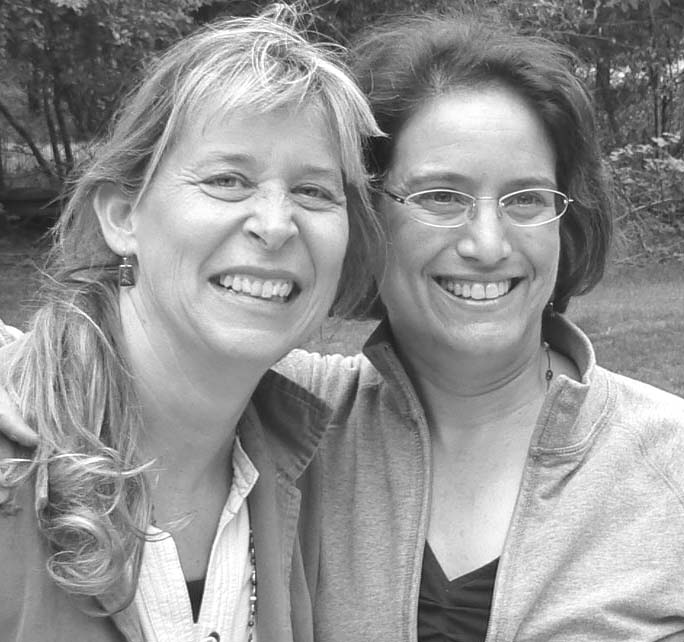
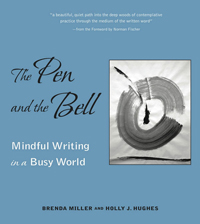
Holly Hughes and Brenda Miller are writers, friends, and authors of The Pen and the Bell: Mindful Writing in a Busy World. Both are accomplished: Holly is a poet, professor, and editor of the award-winning anthology Beyond Forgetting: Poetry and Prose about Alzheimer's Disease; Brenda is editor of the Bellingham Review, and a Pushcart Prize-winning author who teaches at Western Washington University. And both are deeply introspective writers who believe that "writing can be a rich, active form of paying attention to the self and the world."

I'm intrigued by, and appreciative of, the letter writing practice that led to the creation of The Pen and the Bell. What prompted your correspondence?

Holly: That was one of the wonderful serendipities of this collaboration, as we really just fell into it. We’d drafted an outline with chapters then met to discuss our plan. At the end of our session, we decided it looked too formal for the organic process we’d envisioned, so we decided to continue to correspond by letters (via email) instead. Thankfully, we both had a sabbatical that fall, and so the timing was good. Within a few months, we were both loving the correspondence — I was always delighted to find a “Letter from Brenda” in my In Box — and we quickly recognized that our letters were becoming the book we’d envisioned.

Brenda: Yes, serendipity is the right word, because the idea seemed to just arrive — to materialize as a message to which we both said, “of course.” And once we started writing, it was so much fun that it was actually hard to stop. I think I wrote three letters in the first week!

In the introduction you write that it is important to "carve out space for writing in a world crowded with distraction." In a few words, how does one master this seemingly impossible feat?

Holly: It’s hard to answer this in a few words — we share many specific strategies in The Pen & The Bell — but the premise of the book is that by combining mindfulness practice with writing practice, it’s more possible to carve out space and time; the two practices can work synergistically to support each other. For example, by meditating or reading a favorite poem aloud (contemplative reading) before writing, you can more quickly enter a creative state — where the more authentic writing comes from. Other than that, we give suggestions for taking whatever time you have — at a red light or walking to work—to breathe deeply and re-connect with yourself throughout a busy day — and these small mindfulness practices allow us to bring more of our undistracted selves to the page.

Brenda: It’s really about learning to write more quickly — not spending time “thinking” about writing or agonizing about it, but simply writing, even if you have just a few minutes. We give you lots of prompts — in the book and on The Pen and the Bell website — that can give you places to start. It’s also a matter of prioritization: really getting a sense of why writing is important to you, and forming a community (a community can consist of even just one other person) that helps you value this priority.

What did you gain in the process of writing this book, and what do you hope readers will experience? (I cheated, that's two questions!)

Holly: I’ll address the first question. I think we wrote this book for ourselves — we’re both teaching writing full-time, seeing first-hand all the distractions that we and our students face on a daily basis, distractions that sometimes keep us from writing. As the letters evolved, it became clear that we were letting our creative muse help us find strategies that felt in keeping with both the challenges — and the deeper core values — of our own lives.

Brenda: Yes, and we hope our readers will experience the same thing: some support for their creative lives, an excuse or opportunity to slow down and remember what it feels like to focus in a deeper way than our hectic lives (and minds!) sometimes allow.

I like your idea that "contemplation is an active practice." For you, which came first: writing or mindfulness?

Holly: For me, writing came first, as I’ve been writing in a journal since I was a kid. They both came together twenty years ago when I was working as a mariner on the water in Alaska. Looking back, I view that time — what I called “wheelwatch practice” — as a form of mindfulness practice. I began attending meditation retreats and receiving formal instruction about 12 years ago. I became particularly interested in mindfulness practice after reading several books by the Vietnamese monk Thich Naht Hanh and was lucky enough to attend a week-long retreat at Deer Park Monastery in California when he was in residence.

Brenda: I’ve been writing since I was 7 years old, so I guess writing came first! Though children do seem to be naturals at contemplation as well; they can focus a long time on insects, animals, blades of grass. . . I was always kind of a moody child — quiet, introspective — and so perhaps those two modes have always coincided for me.

I'm a collector of words. What are your favorites?

Holly: What a fun question, Drew! I must admit it’s difficult to choose; there so many words I love, both for their meanings and their sounds, their feel as they roll off your tongue. But here are a few of this week’s favorites: waterfall, bumblebee, pomegranate, bladderwrack, stipple.  (The last is from a favorite Hopkins’ poem, Pied Beauty, that has many more great words).    

Brenda: delicious, marble, agile, welcome, pineapple (I don’t know if they’re my favorite words, but they popped around in my mind while I pondered your question. Plus, I’ve been on a pineapple-eating kick lately, and the word just makes me feel happy.)


Friday
Mar232012

Stefanie Freele


I like to make the middle

something sassy and meaty. 

I like to make a fine ending

that swoops.


Welcome to Fast Five — short interviews with my favorite writers. Life may be short but who doesn't have time for five questions?

Stefanie Freele's stories and flash fiction can be found in Glimmer Train, Quarterly West, American Literary Review, Pank, and many other literary journals. Her collection, Feeding Strays, was a finalist for both the John Gardner Binghamton University Fiction Award and the Book of the Year Award. Her stories have been twice nominated for the Pushcart Prize. She recently won the Glimmer Train Fiction Open, and her second collection, Surrounded by Water, will be published in May 2012. In addition, Freele is the Fiction Editor at the Los Angeles Review.

How did you come to writing?

As most writers, I have always loved reading. I never knew that I could become a real writer though until I decided to go for my MFA at the Northwest Institute of Literary Arts: Whidbey Writers Workshop. Up until then, I thought there were readers, people who journaled a bit and then some very gifted folks over there that created their wonderful writing for us readers. Somehow a little whisper: write, grew to a yell: WRITE! and one finished story led to another led to a collection.

Your work is wonderfully distinct. Feeding Strays, a collection of 50 short (and short-short) stories, was a finalist in two prestigious contests, and has been described as loopy, sensitive and "full of strange, original invention." How do you describe your writing content and style? 

I don't know if I can describe it, I may be too close to my own writing, it is like trying to describe yourself. I don't know if I could do that either. I like to not waste much time falling into the beginning, I like to make the middle something sassy and meaty, I like to make a fine ending that swoops. Okay, I'm being silly there, but truly, it is difficult to dissect one's own writing.

Some people say "first thought best thought." Others edit a piece into place. What is your writing process?

Usually a little something nags at me along the way, something someone said, or something I observed and it nags enough that I finally get down to write about it. The little something then somehow births a story. I don't truly know how it works, but for instance, the last story of Feeding Strays, called "Every Girl Has An Ex Named Steve" began from two incidences.

One: I found myself saying just that to a friend when we were dog walking, "Every girl has an ex named Steve" and immediately knew I needed that line, and extra proud because it came from myself and I didn't need permission to swipe it.

Two: I witnessed a teenager in a banana suit standing outside a store while stiffly handing out coupons. I'd never seen a more miserable looking fellow. He oozed misery. He hated that banana suit body-cast more than he hated anything else in his short little life. I was watching youthful disillusionment happening right before my eyes. I felt achingly painfully sorry for him.

Thus, the first line of the story, "We tell her not to date a man in a banana suit."

I edit later when I think the story is told. Then, I use a different part of my brain, one that organizes and chops and perfects.

As the fiction editor for the Los Angeles Review, what do you look for in a story? What do you love to see, and what makes you cringe?

Cliches make me cringe. Overused plots make me wilt. Flowery self-important writing makes my face do the just-ate-a-lemon. Over-reliance on dialogue has a confusedly queasy affect on me and I have been known to drift off during weighty segments of backstory. I love to see more humor, more wacky, more real crisis and conflict, more creative plots.

You are an accomplished writer, reader, poet and editor. What do you know now that you didn't know when you first started writing?

I did not know I would meet so many talented and genuine authors. I've had an enormous privilege, by being both the Fiction Editor of the Los Angeles Review, a former submissions editor with Smokelong Quarterly and speaking at various conferences, where I've been introduced to some beautiful and amazing writers. When you get a signed book from an author you've just met and you go home and love the book, that is a wonderful feeling. I thought being a writer would be very lonely, very isolated and curmudgeonlike but it doesn't have to be.

And, although I knew I loved words, loved stories, loved to read, I didn't know how much that love can just keep growing until you just want to shout about it. But, shout not too long, because hey, I've got a pile of books to read.

Bonus Question: I'm a collector of words and often have my students collect words, too. Do you have any favorite words?

The other day someone used the word bombastic and I found myself in love with that word. I don't think I've ever said it aloud, however I'm going to attempt to insert it somewhere, either in a story, or in an accusation. I really want to tell someone they are being too bombastic. And, I want to be right about it.


Friday
Nov182011

Oregon Poetic Voices

In a world that really

doesn't seem to value

the small, quiet voice,

I think they felt like

they mattered

says Doug Erickson, as he finishes a day recording people and poems in rural Oregon.

Oregon Poetic Voices, founded by Erickson in 2009, is the nation’s largest online poetry repository, offering a comprehensive digital archive of poetry readings from all over the state.

OPV contains recordings of almost every significant Oregon poet — including a 1921 recording of Oregon’s first poet laureate — and over 300 contemporary poets of all ages, backgrounds and accomplishment. Access to the wesbite is free, and participation is open to all.

“We hope to be as inclusive as possible,” he says. “Early on I thought it was important that this not to be a juried project. I felt that to really capture the essence of Oregon and its poets, it was important to leave it completely open to all. It gives the site a mixture of literary, cultural, and anthropological layers.”

Though not a poet, Erickson — who works as special collections archivist at Lewis & Clark College in Portland, Oregon — carries an enthusiasm for the written and spoken word. As a result, OPV is growing fast. He travels town to town, across the state, inviting new, established, and self-described poets to share their words.

“I have had people come on horseback and on bus, from homeless people to the wealthiest of our state,” he says. “Each with a story, and a medium to share their thoughts, ideas, and creativity.”


Doug Erickson, Oregon Poetic VoicesYou are not a poet, yet you appreciate poetry, and think it worthy to archive. Why did you create Oregon Poetic Voices?

I do not self identify as a poet, but I am a writer, and know the highs and low of trying to communicate through printed words. Early on I thought it was important for me to not be a poet, and for this not to be a juried project. Much of the academic world that I live in is peer reviewed and scholarly. While I am a big believer in this type of scholarship, I felt that to really capture the essence of Oregon and its poets, it was important to leave it completely open to all. This has enabled the site to grow much faster that it would have been if every poem and poet was vetted. It also gives the site a mixture of literary, cultural, and anthropological layer to it. I imagine that not only those interested in poetry, but also anthropology, sociology, history and literature, in the future will find this site useful. I hope it becomes a time capsule for the thoughts and ideas of many Oregonians from this time period. 

When and how did you start OPV? 

The idea comes out of the encouragement of William Stafford, who was my colleague and friend at Lewis & Clark, who wrote and encouraged writing every day. When his archives came to the college, and I saw the nearly 50,000 pages of correspondence, I realized that much of these letters were from fellow writers, those that were famous, and those that were just simply trying to write, or become writers.

His teaching philosophy was "no praise, no blame," meaning encourage people to continue to pursue and grow as writers and thinkers. Sometimes praise and blame can lead one down a path that takes away from that seeking. While I don't fully subscribe to that notion myself, I do think in the case of OPV, this approach is a good one. Sure, there are many bad poems, yet there are also some very good, if not great, ones. They all represent a place in time for a writer/poet. Some with bad poems will go on and write great ones, and vice/versa. So, I wanted to capture and create a medium where this could take place.

Oft times historians and archivists wait for the history to come to them, rather than go out and harvest the activity that is happening presently. History is full of examples of recording that survived over time, the ruling class, and the prevailing race. With technology, and hopefully more cultural compassion, we can harvest the history of people, regions, races, genders, and voices, hereto forgotten or destroyed. And we can do it in the season that it is being created. I hope this is what OPV is doing. 

What do you hope listeners will experience? 

I hope they encounter the breadth, and expanse of this collection. There are so many self-identified poets that really feel passionate about their writing, and words. I have had people come on horseback and by bus, from homeless people to the wealthiest of our state. Each with a story, and a medium, to share their thoughts, ideas, and creativity. I think that Oregon is unique in having so many poets, but I also think that if other states were to try this same project (and I hope they do!) they would find that many people would come forward to share their writings. 

Here's an excerpt of an email I received. I share it with you because I think it captures the feelings that many have when they come together and are able to share their work. I just happen to be the person who brings the equipment. The real OPV is simply the poets, young old, good, bad, famous, and not famous. Each share equal footing here, and collectively make up the voice of Oregon:

 . . . I'm the woman who was so emotional I insisted on hugging you and thanking you for letting our voices be heard. What you may not know but should, is that when my friends came out of the recording room their faces showed the joy of accomplishment. We sat around the table and our poetry tribe found a reason to be a community together because a community happens sometimes when you don't know it will and reading our work brought us together. Reticent, shy people bubbled over with talk. People who I'd had to nag and keep after dared to come and do something they truly feared but wanted to do so much and, because of you, they just did it.  . . .  In such a complex, difficult, unknowable place as this earth, this life, I love when something is so clearly GOOD, and Oregon Poetic Voices simply is. 

How is OPV funded?

OPV started with an initial grant from the Library Service and Technology Act, a grant distributed to all 50 states and administered by the State Library. The money originates with the Institute of Museum and Library Services.

We only have funding through January 31, 2012. After that, well . . . we are working on it. We are not really in a position to take donations, unless some angel wants to come in and be a major funder. We are looking to small granting agencies to see if we can keep some of this program going after Feb. 2011. I am Head of Special Collections and Archives here at LC for the last 20+ years, so I will continue in that role, and hope to keep OPV alive in some small way if no money comes our way. 

Bonus Question:  Anything I didn't ask that you'd like to answer?

None of this would be possible without the hard work and dedication of my team at Lewis & Clark College: Melissa Dalton, poetry project fellow; past poetry project fellow, Tessa Idlewine; Jeremy Skinner and Paul Merchant, my colleagues in Special Collections and Archives; OPV's design team Jeremy McWilliams and Annelise Dehner, and student interns and assistants past and present, Rachel Sims, Chris Keady, Natalie Figuroa, Anna Fredrickson, Caitlin McCarthy, and Becca Dierschow; workshop leaders, and all the local folks in communities across Oregon who helped to organize and prepare for OPV, and for making us feel at home in your communities. 

To learn more, and listen, to Oregon Poetic Voices, visit www.oregonpoeticvoices.org.


Monday
Oct102011

Paulann Petersen


We write to discover, to define

— moment to moment to moment —

who we are, who we are becoming.

This happens as we write.


Because a few direct questions can offer insight, I'm happy to present Fast Five — short interviews with my favorite writers. Life may be short but who doesn't have time for five questions — and a chance to win a great book?  (To win, simply post your name and contact info in the comments section. See details below).

Paulann Petersen, Oregon’s Poet Laureate, is a former high school teacher and author of five poetry collections and four chapbooks. She has led workshops and given readings in hundreds of places — from Powell's in Portland to Omsania University in India — and in nearly every nook and cranny of Oregon. A Portland native, she is a member of Friends of William Stafford and organizes the annual Stafford birthday readings. Petersen’s most recent book is The Voluptuary, published in 2010. 

You are an accomplished poet and teacher, and now Oregon's esteemed poet laureate. What do you know now that you didn't know when you first started writing poems?

I know now what I couldn't have possibly known when I began writing poems: how the process itself would buoy and sustain and inform my life.  We write to create ourselves, to discover, to define — moment to moment to moment — who we are, who we are becoming. This happens as we write. Not until I was immersed in the process could I begin to realize its potent effect.

You've been called a writer of embodied poetics, and have said, "I believe in body poems, poems that rise from the body."  Would you please elaborate?

A poem is a creature of sound. A poem comes to us, all poems come to us, through the oral tradition. Yes, a poem has a certain life as mere text on a page. But that life as text is only a fraction of the poem's complete life. A poem can't assume its complete life until it's been given voice.   

A poem has a sound form, it's comprised of a sequence and combination of sounds. A poem has musical devices. A poem has kinetic energy. A poem has risen from the physicality of its maker, and it speaks to the physicality of a listener.

For me, writing a good poem means writing an embodied poem.

You've written five full-length poetry books and taught hundreds of classes. What makes a poem work?

Sound form. Compression. Line integrity. Unpredictability — a little or a lot. A sense of incipient recklessness. A sense of conveying something that's coded in the blood. These make a poem work.

A good poem is a vehicle for transformation. It transforms the listener/reader as she or he hears or reads it.  A good poem, in the process of its making, transforms the poet.

Of all your poems, which is your favorite? Why?

Hmmmmm. I avoid hierarchies when I can. Vertical structures are dicey at best. (Best. There's one of those vertical structure words!) So picking a favorite poem: that's a dicey proposition. But there are two poems that I read frequently when I'm giving readings. And both of them sonically and conceptually feel right to me, even after repeated readings. They are among a group that feel like embodied poems, time after time.  "Appetite"  and "Bloodline." 

Bloodline

The moon is wet nurse
to roses. She suckles
each soft-mouthed poppy.

Blame her for menses.
Rail at her for the craving
to binge and purge.

Please her when you choose
to delay the day for planting,
biding your time
until night has fattened
her silver torso. Praise her
when the fleck of seed
poked down into damp dark
takes hold and swells.

Any girl-child is always
her offspring.

Upbraid her for your daughter's
sass and door-slams,
that hot hurry to be what most
differs from you.

Long ago, the moon decided
on a pathway against the route
stars take. No one else
would dare to walk
the black sky backward.

- Paulann Petersen


I'm a collector of words. What are your favorites?

I'm smitten with noun lists. I use them when I'm teaching writing workshops (workshops designed to generate new writing from participants). One of the noun lists I give to participants contains nouns I took from my own work. I often remark that I couldn't have a noun list that didn't contain blood, magpie, magnolia, ink, salt, skin and moon. 

Bonus Question: Is there something distinct about an Oregon poet? or Oregon poetry?

Oregon poetry, like Oregon itself,  is characterized by remarkable variety.

Oregon is mountains, ocean, high desert, rain forest. It's the hotsprings in Hart Mountain Antelope Refuge, the Church of Elvis in downtown Portland, pelicans on Klamath Lake, herons in oaks Bottom on the Willamette. Oregon is abundance; it's variety, vast and gorgeous. Our state teaches its poets inclusiveness and gratitude. Oregon encourages a wide embrace, and its poetry does indeed have a very wide embrace.

Another distinction: my bet is that there are, given our total population, as many good poets per capita in Oregon as anywhere on earth.


Meet Paulann

In Waldport, Oregon
Saturday, October 15, 2011 at 2pm
Waldport Community Center, 265 NW Hemlock St.
Free

In Medford, Oregon
Saturday, November 5, 2011
Oregon Book Fair
Free

See more events on Paulann's website.

Win this book!

To win The Voluptuary by Paulann Petersen, add your name and contact info in the comments section below. Feeling shy? Email me, add 'Book Drawing" in subject line:  dcm@drewmyron.com

Your name will be entered in a drawing, and the winner announced on Monday, October 17, 2011.