Whatcha reading? I've been in a book frenzy, poring through a mix of fiction, mystery and poetry. It's a scattered but satisfying book list.


Whatcha reading? I've been in a book frenzy, poring through a mix of fiction, mystery and poetry. It's a scattered but satisfying book list.
I wanted to lose myself in books. Because the day began with rain, I felt no guilt in this retreat. But then the sun blazed through the clouds and it became difficult to justify my languor.
Writer Amy Krouse Rosenthal knows this feeling, too:
Rainy Day
Rain is your pass to stay inside, to retreat. It’s cozy and safe, hanging out on this side of the gray. But then the sun comes out in the afternoon, and there’s disappointment, even fear, because the world will now resume, and it expects your participation. People will get dressed and leave their houses and go places and do things. Stepping out into the big, whirling, jarringly sunny world — a world that just a few minutes was so confined and still and soft and understated, and refreshingly gloomy — seems overwhelming.
— from Encyclopedia of an Ordinary Life

It’s autumn, officially.
Unofficially, it’s submission season. This time each year literary journals open their gates to accept a flood of poems and stories from hopeful writers.
It’s the best of times (publication!) and the most trying of times (rejection!). Lots of hurry, lots of wait.
I like poet Bruce Cohen’s take on the submission process. It’s funny, telling and true:
I wish I could tap together my ruby red L.L. Bean slippers and post questions to a Wizard of Oz Poetry Editor so I could unravel the esoteric truths and mysteries about what factors, what esthetics, he really considers when deciding whether or not to accept my poems, what the deal breakers are. . . .
Read the full essay (from Rattle, Spring 2009) here.
It's a powerful endeavor, both creating the roster and reading the books, and I'm happy to recognize some of my favorites (Toluca Street by Maxine Scates; Here, Bullet by Brian Turner), and to add the others to my growing list of must-reads.
How about you? Have you read all 150? What are your favorites? Are there missing teeth in this ambitious compilation? I'm eager to know what you think.
Some people say that the best stories have no words. . . . It is true that words drop away, and that the important things are often left unsaid. The important things are learned in faces, in gestures, not in our locked tongues. The true things are too big or too small, or in any case always the wrong size to fit the template called language.I know that. But I know something else, too . . . Turn down the daily noise and at first there is the relief of silence. And then, very quietly, as quiet as light, meaning returns. Words are the part of silence that can be spoken.
— from Lighthousekeeping, a novel by Jeanette Winterson
A recent news-feature in the Oregonian has stayed with me for days. I don't usually care for first-person news stories (too much reporter, not enough story) but in a piece about emergency food pantries, writer Inara Verzemnieks poetically replaced data with humanity to deftly capture the core of ache:
As I restock bags of beans, I can hear her voice, raw and sustained, outside the door, wondering what she will do now, and I think about how at certain times in our lives, it's the aggregate of little things that threaten to crush us. But that also means, as trite as it sounds, it's an aggregate of little things that might also carry us through.
Many thanks to those who entered the drawing to win Catching the Limit by Mark Thalman. Entries arrived via blog comments and email pleas. From a blind drawing, we are pleased to announce the winner is . . . .
Jerry Luger of Corvallis, Oregon.
Thanks to everyone for tuning in, reading on, and taking part. Get your copy of Catching the Limit at www.markthalman.com. Or urge your local library to purchase a copy so even more readers can enjoy the poems.
Morning Pages
Timed Writing
500 Words
It’s all the same. All attempts to provide some structure and productivity to creativity.
At Inkygirl, Debbie Ridpath Ohi offers a word-count challenge. I balked at first.
500 words. Do I really need a gimmick to get me to write? Do I really need a regime, a routine, an edict to create?
As a writer, I shouldn’t need structure or rules to make me produce. If I’m a writer, I will write. Do painters say, I must paint for 10 minutes today. Or I have a painting schedule ?
As a writer, do I really need rules and schedules?
Yes, sadly, yes.
Because, unlike painters, dancers and others artists, I avoid what I love. I avoid writing even when writing is what I love most.
It’s perverse, and over the years I’ve filled days and journals writing too much about not writing.
There’s no shortage of get-to-it books: The Artist’s Way, The War of Art, Writing the Life Poetic, and scores of online workshops and retreats.
They are good and helpful and I always feel grateful for the boost. The trouble is the writer-high is too darn short. I fall back and away. Like my morning jog, it never feels easy.
I think it will. Every morning I run (well, a slow jog, really), I expect to feel better, go faster, have more endurance. But everyday I am just grateful to get through it. As I slog to the end, I feel a buzz of accomplishment and that’s what gets me going again the next morning.
Here's the kernel of truth stuck in my stubborn back molar: Writing is an exercise. Like my jogging, writing may never get easier but my creative muscles do get tuned and ready each time I show up. And the sense of accomplishment does always arrive at the end.
500 words. Yes! I showed up. I wrote.
It’s a routine. A schedule. A commitment. And it keeps me going.
How about you?
WIN this book!
Scroll down to enter.
Welcome to the second installment of Writer Revealed, an occasional series featuring interviews with writers who intrigue and inspire.
many writers, it’s difficult finding a publisher or winning a contest. This manuscript has been a semi-finalist for the Walt Whitman Award and a few other contests. Four years ago, it was selected to be part of Bedbug Press – Fairweather Books, Northwest Poetry Series. My parents were always very supportive and positive about getting a good education. When I was growing up, they gave me a lot of opportunities: snow skiing, playing golf, fishing, guitar lessons, taking us on trips around Oregon. My mom read Tom Sawyer and Huckleberry Finn to me when I was about five. She loved taking my sister and me to the public library to check out books. My grandparents, who were great story tellers, used to own the Willamette Pass Ski Area and had a cabin at Odell Lake. That’s where many of the poems in the second section of the book take place.
Please tell us about your writing process.
I write like an artist paints. (If you visit my website, you can also see some of my paintings.) Some poems may take a few months to finish, others have taken 16 years. A lot of times, a poem will be almost finished, but I am waiting to learn or discover what it needs to give it that finishing touch. Some poems go through a lot of revisions, others don’t. If I can write a few good lines each time I sit down, I’m satisfied.
What is your writing style?
I write lyrical poetry. Each word has its own music, and a poem has to sound right and have a presence on the page. I like to have internal rhymes, but not hard rhymes at the end a line. I love good similes and metaphors. It’s probably just easier to read you a few lines from “North Umpqua, Summer Run” so you get the idea.
In a smooth flash of motion,
deft as a blade, the fish strikes
and the surface explodes.
Trembling violently in air,
amid spray and foam,
the steelhead blazes like a mirror catching sun,
falls back, extinguishing the fire,
only to lift again,
a flame out of water.
Your poems have such a rich sense of landscape and place – specifically Oregon. Do you consider yourself a regional poet, a nature poet?
Someone said that all writing in some sense is regional, but when I sit down to write, I don’t think of myself as a regional or nature poet. Catching the Limit is about the Oregon Coast, the Willamette Valley, and the Cascades. Sure, I am interested in how a whole forest continually renews itself as in my poem, “In the Silence of a Pine Cone Falling”, or how different trees decompose in “Blowdown." There is a lot of nature in the book, but hopefully the themes and the “human condition” will transcend any regional boundaries.
Your work wonderfully combines your specific experiences/observations with universal understanding. How do you do this, and is it intentional?
(Laughs briefly and good naturedly.) Sometimes “art” happens! I can only think of a couple of poems where it is intentional. Such as the last line in “On the Dock at Evening” where the narrator says, “I have lived my life for just this moment.” That line is a response to James Wright’s well known poem “Lying in a Hammock at William Duffy’s Farm . . .” where his narrator claims, “I have wasted my life.”
Born in Oregon
Some days I am a fir. Squirrels eat from my limbs.
Other days I am a rhododendron. My genes are coded
as cuneiform. Toadstools and moss grow in the caverns
of my lungs. I am accustomed to the sky,
gray as wax paper.
What is your favorite poem in Catching the Limit and why?
I don’t have a favorite. It depends on my mood. My poems are like children, and I try to treat them equally. I like it when people tell me what their favorite is. Everyone has their own experiences and perceptions they bring to a poem.
Do you have a tight group of poet friends? And how would you suggest others cultivate a writing network?
Yes, I have a group of poet friends, most who I’ve known for a long time. However, people have become so spread out, its really the Internet that makes staying in touch possible. Over the years, my wife, Carole, has become one of my best editors, because she’s seen so much of my work and understands what I am trying to do. As far as cultivating a writing network, if a person attends writing workshops, they might find some like minded poets who want to start their own poetry group.
Where can we get your book?
Presently, Catching the Limit, can be ordered from my website, markthalman.com. Unfortunately, Tony Gorsline, my publisher, passed away this summer from cancer. With Tony’s passing, Bedbug Press – Fairweather Books did not survive, so I don’t have any small press distribution at this time. However, I will be giving some readings at bookstores, and I’ll be signing books after my reading at Wordstock (in Portland). In a few months, you should be able to find it on Amazon.com. However, if you purchase it from my site, you will always get an autographed copy, and I’ll ship it to you right away.
See Mark Thalman this fall!
• Looking Glass Bookstore
Portland, Oregon
Beyond Forgetting - Poetry Reading
Saturday, September 19, 2009, at 3pm
A reading featuring: Tess Gallagher, Holly Hughes, Alice Derry, Joseph Green, Kake Huck, Judith Montgomery, Drew Myron, Paulann Peterson, and Mark Thalman.
• Wordstock
Portland, Oregon
Oregon Convention Center
Sunday, October 11, 2009 at 3pm
* WIN a copy of Catching the Limit!
It's easy. To enter, simply write a comment below, or send an email to dcm@drewmyron.com. Provide your name and contact information. A winner will be selected at random from the entries. But hurry! All entries must be received by September 12, 2009. The lucky-ducky-limitless winner will be announced here.

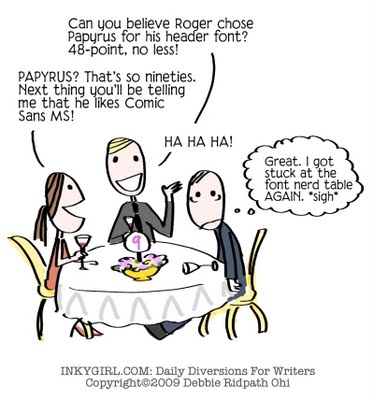
Comic courtesy of Debbie Ridpath Ohi, a Toronto-based freelance writer, illustrator and the creator of InkyGirl.com
Writing White Papers has announced its 4th annual Best Blogs for Writers contest.
Reason 1: Few things are more self-serving than a blog. I’ll set aside false humility and admit this blogosphere is deep and dark and I could use a thin slant of light.
Reason 2: Let’s show ‘em a writing blog that blends art and words while encouraging creative leaps.
Reason 3: Is anyone out there? Your vote could be the balm to allay fears that I am all alone in this literary life.
Vote now! It's easy, and operators (or blog masters?) are standing by, eager to accept your opinion.
To vote, visit Writing White Paper's nominations page. Entries must include:
Blog name: Off the Page by Drew Myron
URL: http://drewmyron.com/main.htm
A brief explanation of why you read this blog.
Entries are due Sept. 11, 2009.
Thank you!
My post office box — always a source of pleasure — was especially delightful today. Two books arrived! Both funny, tender, light but not vapid. (As a note, I’ve been on a library kick lately but these two are purchase-worthy):
I have not survived against all odds.
I have not lived to tell.
I have not witnessed the extraordinary.
This is my story.
As usual, I’m late to the party. Encyclopedia was published in 2005 and has earned loads of accolades and attention. She’s now deep into another creative project, with yet another twist: The Beckoning of Lovely, a film being made by 200 strangers. Click below to view video.
How Not to Act Old by Pamela Redmond Satran
This book, and its companion blog, is a hoot. After a quick read, it’s clear I'm exhibiting sure signs of geezerhood. Evidence of age:
- using words like hoot and geezer
- leaving voice messages
- talking loudly into my cellphone
- still watching MASH and Seinfeld
The author is laugh-out-loud funny, offering 185 witty and wry directions. Published just this month, the book zoomed to the New York Times bestseller list in its first week, proving there are a lot of old people desperate for disguise.
Book suggestions abound! Several (young-ish) friends and family members have chimed in with their faves:
• The Phantom Tollbooth, by Norton Juster, got the thumbs up from my book-loving niece Kimberly, age 11.
• Mad Libs. Oh, how I love these fun word lessons cloaked in silly fill-in-the-blank stories.
• A Single Shard, by Linda Sue Park, was recommended by dedicated reader/writer Eliza.
Got any more good reads? What are your sons, daughters, nieces, nephews, friends and neighbors reading? What have I missed? Keep those suggestions coming!
I remind myself that we live in a society in which people still think of themselves as 'young' when they are 50. When do we stop being young adults? Is there any reason a 60-year-old wouldn’t be able to find some pleasure, and perhaps some edification, in a good Y/A [young adult] book?
— Marilyn Nelson, author of 21 poetry books, for adult and young adult readers
Written for young readers, this season's favorites delivered fresh language and perspective:
• Speak, by Laurie Halse Anderson
• Absolutely Normal Chaos, by Sharon Creech
• From the Bellybutton of the Moon and other summer poems, by Francisco X. Alarcón
After a long run of adult fiction that works the predictable paths of mother-daughter strain or husband-wife ennui, I’m relieved to read young adult dilemmas of friendship, trust and identity. None of it trite and all of it memorable.
As I prepare for a new school year (I’ll be leading creative reading and writing activities for grade school, middle school and high school students), I’m seeking new material.
So, here's a call to all ages: What are you reading?
Young (and not so young) minds are eager and waiting. I'll absorb, savor, and post your suggestions here.
I’m fresh from the Forecast tour.
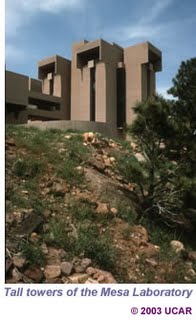
But the journey was worth the travel: Last week, Forecast — the Tracy Weil-Drew Myron art-poetry exhibition — opened at the National Center for Atmospheric Research in Boulder, Colorado. Designed in the 1960s by I.M. Pei, the Mesa Laboratory is a collection of abstract, geometric concrete forms perched atop the highlands and in the shadow of dramatic red sandstone formations known as the Flat Irons.
It's a stunning setting for our abstract, horoscope-inspired art. And, as a glutton for press, I am delighted with the attention from Westword and the Colorado Daily. Read all about it here and here.
Kindness
Before you know what kindness really is
you must lose things,
feel the future dissolve in a moment
like salt in a weakened broth.
What you held in your hand,
what you counted and carefully saved,
all this must go so you know
how desolate the landscape can be
between the regions of kindness.
How you ride and ride
thinking the bus will never stop,
the passengers eating maize and chicken
will stare out the window forever.
Before you learn the tender gravity of kindness,
you must travel where the Indian in a white poncho
lies dead by the side of the road.
You must see how this could be you,
how he too was someone
who journeyed through the night with plans
and the simple breath that kept him alive.
Before you know kindness as the deepest thing inside,
you must know sorrow as the other deepest thing.
You must wake up with sorrow.
You must speak to it till your voice
catches the thread of all sorrows
and you see the size of the cloth.
Then it is only kindness that makes sense anymore,
only kindness that ties your shoes
and sends you out into the day to mail letters and purchase bread,
only kindness that raises its head
from the crowd of the world to say
it is I you have been looking for,
and then goes with you everywhere
like a shadow or a friend.
— Naomi Shihab Nye
from The Words Under the Words: Selected Poems
A poem
makes us see
everything for
the first time
Francisco X. Alarcón
from Laughing Tomatoes and Other Spring Poems
Stunned, I quietly reeled through a catalog of my favorite musician/poets: Jackson Browne, Michael Franti, Tracy Chapman, Roger Waters . . .
Over the next few days I grew indignant. Of course poetry is music! Of course music is poetry! Both share a musical language, a crafting of words and sound. I came to poetry through music — for pete’s sake! As early as second grade I was reciting Harry Chapin’s Cat's in the Cradle to my peers.
In the cooling off period since the songwriting session, I have tuned down emotion and turned up intellect. If music is not poetry, What is poetry? Through research I gathered numerous esoteric — and beautifully written — responses but a tangible answer eludes me. And if I can’t answer the question, how can I explain to others why poetry is in everything, including music?
I’m looking for answers, and I’d love to hear from you.
I haven't been to Venice. After reading the National Geographic story (Vanishing Venice, August 2009) on the Italian city wrought with tourists, I have lost desire.Here, where everything anyone
needs to live and die must
be floated in, wrestled
over bridges, and muscled
up stairs, time is measured
by the breath of tides,
and space bracketed
by water.
The story concludes just as poetic:
Kisses end. Dreams vanish, and sometimes cities too. We long for the perfect ending, but the curtain falls along with our hearts.
Beauty is so difficult.
Skip the trip to Venice. Read Cathy Newman’s work instead.
Photograph by Jodi Cobb, for National Geographic.
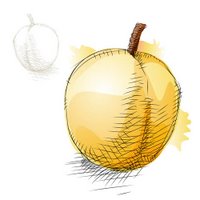
the first bite
is deep, past
the soft nap
of summer
inside, orange
is more than color
turns mealy, less
than expected
like this season
that grows
warm in
short bursts
turns cloudy
and quiet
this fruit with its
inviting orange
says savor
but slowly
enjoy this
palm-size treat
traveling from soil
to tree
to market
to me